Updated. If anything, 2010 was the year when our reliance on web services went through the roof. Whether it was social networking on Facebook, calling our friends on Skype or remixing content on Tumblr, we spent an inordinate amount of time on the Internet. And just as our usage went up, so did our expectations of uptime and reliability of these services.
Nevertheless, as the recent Skype outage has shown, Internet-based services have a way of going down. Folks from AlertSite and Pingdom, two web-monitoring services, have put together a list of Internet outages that went down in 2010. I added some of my own to the list. Here is a summary of what I think were the top outages, followed by a small poll for you to pick the biggest web outage of 2010.
Facebook. Outage started on Sept. 22 and ended on Sept. 23, 2010. Service went down for about a third of the Facebook subscribers on day one, and nearly 66 percent on day two. Cause: Third party network provider. Facebook had a major outage in April 2010 as well.
Twitter. It’s the most crash-prone social service out there, thanks partly to its communication underpinnings. Twitter crashed in Jan. 2010 in the wake of Haiti earthquake, then later during the World Cup in June 2010.
Skype. On Dec. 22 and 23, the Internet telephony service went on the blink for millions of users. The cause was described as some errant Windows-based supernodes, but the real cause is still unknown.
Tumblr. The New York-based blogging service was offline for nearly 24 hours and most of its users were offline in early December. Tumblr described it as a database cluster failing during maintenance.
Updated: Gmail. Google’s email service had a rough
20102009. It was offline for about 2.5 hours, and the outage impacted many users in Feb.20102009. It went down again in March20102009 for 36 hours, and in Sept.20102009, routing issues caused the service to go on the blink.The Gmail outages actually occurred in 2009, not 2010. It’s a testament to how dependent we are on Gmail that it was still fresh in our minds. As such, I’ve removed the Gmail option from the poll.Foursquare. Down for 11 hours on Oct. 5 because of database problems. It crashed again on Oct. 6 for about six hours.
PayPal. In Oct. 2010, PayPal went on the blink for about 4.5 hours, again due to networking problems.
Bonus Mention: Wordpress.com. The hosted blogging service went down for 110 minutes in Feb. 2010 due to networking configuration problems. It took down a majority of the blogging world for a few hours.
Friday, December 31, 2010
The Biggest Internet Outage of 2010. Can we adapt in 2011? #business and Web reliance


Tuesday, December 21, 2010
Gmail to Allow Users to Make Free Phone Calls to the US & Canada in 2011 via@mashable
Google has announced that Gmail users will be able to make free phone calls to the U.S. and Canada through 2011. When calling was added to Gmail back in August, the company said that it’d be making such calls free “for at least the rest of the year,” with per minute rates starting at $0.02 per minute for international dialing.
The service made a major splash initially, with 1 million calls placed in the first 24 hours and pundits predictably calling the service a potential Skype killer. That said, we haven’t heard many updates about the traction the service is getting since then, though free calling for all of 2011 certainly stands to lure more users.
We’ve reached out to Google for some updated numbers and will post here if we hear back. In the meantime, let us know in the comments if you’re making phone calls from Gmail.
Monday, December 20, 2010
What Kris Kringle and The Winter Warlock know about Goals & Success. #SantaKnowsSuccess. #business
What Kris Kringle and The Winter Warlock know about Goals and Success
Did you watch “Santa Claus is coming to Town” the other night? One of my favorite moments in the classic holiday special is when Kris Kringle helps the Winter Warlock and sings *“Put One Foot in Front of the Other”. The lyrics of this holiday favorite are pretty telling about goals.
Put one foot in front of the other, soon you’ll be walking cross the floor. Put one foot in front of the other, and soon you’ll be walking out the door“.
Setting goals is all about reaching something but to me, goals are not only the end result but the steps to get there.
What are you doing every day, every week and every month to get there? That is as important and often more important then the actual goal itself. Why? Because if you can set goals that are achievable; how many cold calls you will do a day, how many existing or past clients you will meet within a week, how many strategic alliance meetings you will set in a month etc. etc. these things are controllable by you.
Controllable mini goals allows you to track what is working and what isn’t so you can begin to carve out what is ultimately the steps to reach your ultimate goal.*Put one foot in front of the other
And soon you’ll be walking cross the floor
Put one foot in front of the other
And soon you’ll be walking out the door
You never will get where you’re going
If you never get up on your feet
Come on, there’s a good tail wind blowing
A fast walking man is hard to beat
Put one foot in front of the other
And soon you’ll be walking cross the floor
Put one foot in front of the other
And soon you’ll be walking out the door
If you want to change your direction
If your time of life is at hand
Well don’t be the rule be the exception
A good way to start is to stand
Put one foot in front of the other
And soon you’ll be walking cross the floor
Put one foot in front of the other
And soon you’ll be walking out the door
If I want to change the reflection
I see in the mirror each morn
You mean that it’s just my election
To vote for a chance to be reborn.Click Here to Hear it: http://www.santasearch.org/playmusic.asp?ID=2686 (sing it with me :)
Sung by Mickey Rooney, Keenan Wynn in ‘Santa Claus is Coming to Town’ (1970).
Best #Business Apps to help streamline your org via @Inc ~Love @TripIt & @DropBox. #iphone apps #android
Best Business Apps of 2010
0
Hours0
Minutes5
Seconds
3 of 7
Courtesy CompanyCourtesy CompanyCourtesy CompanyCourtesy CompanyCourtesy CompanyCourtesy CompanyCourtesy Company


Dropbox (iPad)GroupMe (iPhone & Android)PDF Expert (iPad)Yammer 3.0 (iPhone)OmniFocus (iPad)Kik Messenger (iPhone and Android)TripIt (iPhone, Android, and Blackberry)
Forget having to e-mail yourself documents. This descendent of the Web-based version lets users sync up their Dropbox files between desktop, mobile, and iPad and share links to documents in their Dropbox with just a few taps of the finger. Label a document as a favorite, and view it even when you don’t have an Internet connection. “I couldn’t live without this,” says Raven Zachary, president of app development and consulting firm Small Society. While the app is free, Dropbox’s service includes tiered monthly pricing for more than 2GB of storage.
Price: FreeLaunched in August, this app allows users to organize phone contacts by groups and send text messages to those groups, smartphone user or not. The app also lets its users place a conference call with entire groups by dialing a dedicated number. For a company like Thrillist that throws frequent events, GroupMe has been a crucial addition to its business. “Everyone involved in throwing the event can be on one group text and can see what everyone else is seeing,” says Thrillist CEO Ben Lerer, whose VC firm has invested in the start-up. “Then if there’s an issue, one click and we’re all on a conference call together. Very slick.”
Price: FreeNeed a great app for viewing and annotating PDF files? This is it. Users can add text notes to files or even draw additions with their finger. For Zachary of Small Society, this is the app he uses to sign and annotate contracts on the go.
Price: $4.99The service that some describe as "Twitter for business" released the third version of its iPhone app in 2010. The new version still lets bosses on the move communicate with their employees in group chats in real-time, but includes important new features such as the ability to e-mail and call contacts from the app. “I’m able to respond to inquiries, frustrations and successes on the fly,” says College Hunks Hauling Junk president Nick Friedman, “allowing for us to successfully implement a virtual open door policy in our organization."
Price: FreeThis app is task management software on steroids -- minus all the creepy side effects. Have a task to complete in a specific location? The Map tab shows the distance between the task’s location and your current location. Or click on the Forecast tab to view tasks for the coming week. The price may be steep, but the combination of the features and an elegant user interface and design will make you forget about it. “This app is my brain,” says Jeff Scott, founder of 148apps.com, a popular app news and reviews site. “It’s a mega-organizer app with great options for keeping me on track.”
Price: $39.99This new app was recently pulled from Blackberry’s App World because of a dispute over its similarities to Blackberry Messenger, but it’s still extremely popular in the iPhone and Android app stores. The app turns text messages into real-time instant messages and lets users send them to users on different smartphone platforms. “Amazing for communicating like Blackberry Messenger, but with anyone and free no matter where in the world you are,” says Grasshopper Group co-founder David Hauser.
Price: FreeNo, this app did not launch in 2010, but it earned a spot on this list for the continuous high marks it receives from business owners who travel often. “This has been so useful from checking a flight time to getting a hotel confirmation number,” says Hauser of Grasshopper Group. The app organizes all your trip itineraries in one place and offers maps and directions to make business travel as worry-free as possible.
Price: Free
ADVERTISEMENT


Friday, December 17, 2010
Top Ten Ways to Ruin a Sale
Monday, December 13, 2010
10 Burning Questions About Why Some Entrepreneurs Fail & Others Succeed. via @BusinessInsider. #business #success
Small business owners & entrepreneurs- this is worth a read.
Thursday, December 9, 2010
Agressive, Risky Bold.."People with 'warrior gene' better at risky decisions?
It's been called the "warrior gene" – a mutation that seems to make people more aggressive. Now researchers report that people with this gene may not be aggressive, just better at spotting their own interests.
Previous research has found that people with MAOA-L, a gene that controls signalling chemicals in the brain, can be more aggressive. But there is enormous controversy about this, as the gene's effects seem to vary with people's backgrounds.
Cary Frydman and colleagues at the California Institute of Technology in Pasadena have now found that people with MAOA-L "just make better choices", says Frydman. "This isn't the same as aggression."
Tuesday, December 7, 2010
Top Five Networking Traits
http://ping.fm/uIZoW
Monday, December 6, 2010
Closing More Sales Tip: Track Closing Ratios
Join me on Twitter: GretaSchulz
When’s the Best Time to Publish Blog Posts? via @problogger & @DanZarrella - favs for #blog
Very Interesting the different times and days that people read and respond to posts.
When’s the Best Time to Publish Blog Posts?
This guest post is by HubSpot’s social media scientist, Dan Zarrella.
Of all the data analysis that I’ve done, day-of-week and time-of-day data has been consistently the most popular. So in preparation for my upcoming webinar, titled Science of Blogging, I decided to combine all of my existing data on timing with my new research into one master post on the subject.
The first time I looked at blog post timing was when I was analyzing retweets. I found that retweets exhibit a strong diurnal pattern, in that they’re more common during the day and less so at night. I noticed that retweet activity tended to peak around 4pm EST, suggesting that this might be the best time to tweet a blog post for maximum potential retweet reach.
When I looked at retweet activity over the days of the week, I saw that they peaked later in the work week, specifically on Friday.
Since I first published this graph, the most frequently cited piece of this research has been the idea that Friday at 4pm is the most retweetable time of the week. While your niche maybe different, this data was based on analysis of nearly 100 million retweets, so in aggregate, Friday at 4pm is indeed the most retweetable time of the week.
Moving on from retweets, I started studying Facebook sharing and discovered some things that surprised me about timing there, too.
First, while major news sites and blogs publish articles during the work week, articles that are published on Saturday and Sunday tend to be shared on Facebook more than those published during the week. Perhaps one reason for this is that (as Wired reported), more than 50% of American companies block Facebook at work.
Next, I looked at the effect that the time articles were published had on the number of times they were shared on Facebook. I found that while there is a fair amount of variation, articles published in the morning, around 9a.m. EST, tended to be shared more on Facebook than articles published at other times of the day.
Looking back at these four data points, it may seem that they’re contradictory, but thinking through them a bit more, we can see that they is not necessarily so. Both day-of-week charts tell us that we should experiment with publishing articles later in the week—on Friday and Saturday specifically.
And by publishing posts early in the day, but tweeting them later in the afternoon, we can stimulate both Facebook shares and retweets.
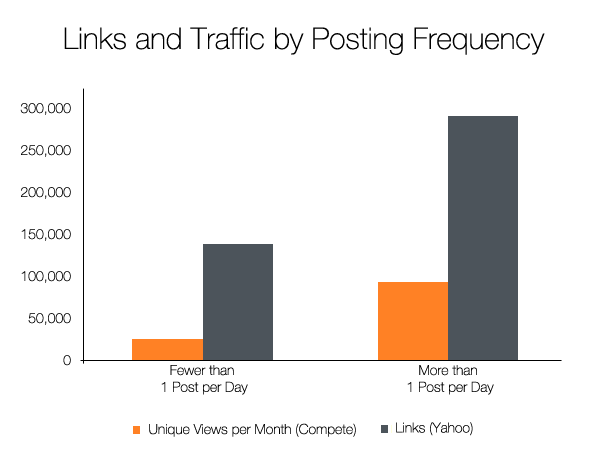
I found that among very popular blogs, publishing multiple times per day led to a huge increase in a blog’s success. This tells us that rather than focusing one perfect day or time, we should aim to publish at many times, and on many days.
Have you experimented with post timing and tweeting? What has your experience shown about the best times of day or week to reach your readers?
Dan Zarrella is HubSpot’s social media scientist. This post contains data from his upcoming webinar The Science of Blogging, taking place on December 9th.
Your Attitude Needs Adjusting to CLOSE More Sales - short Video Tells you how.
Wednesday, December 1, 2010
exciting outlook from cyber monday!
Monday, November 22, 2010
Try to please everyone and no one ends up happy with the results.
Monday, November 15, 2010
Chamber of Commerce Awards so important!#business #sales
I believe in these awards. Don't forget your clients, prospects and colleagues.Givers Gain!
Chamber looking for 'Impact' businesses
Phoenix Business Journal
Date: Monday, November 15, 2010, 1:32pm MST
Read more at www.bizjournals.com
The Greater Phoenix Chamber of Commerce is accepting nominations for its annual IMPACT Awards through Jan. 19.
Nominations are being accepted for enterprising business owners who have made an impact on their community in the past year.
Awards will be given to businesses and owners in categories including innovation, response to adversity, community involvement, company culture and the Impact Business of the Year.
Nominees must have three years in business, be a member of the chamber or partner chambers, and have a business with no more than 150 workers.
The awards will be presented during the annual Impact luncheon to be held in May of next year.
For more: www.phoenixchamber.com/impactawards
Business Cards - Best Option to make them Convert to Clients
When I go anywhere -- a lunch, a networking event, a fundraiser -- people are constantly giving me business cards, sometimes even before they say "hello." We put so much emphasis on these 2-by-3 cards -- and for what? Do you think it's going to sell for you? Have you experienced the people who hand out so many cards that you want to know where they get them printed so you can buy stock?
We also get this question from lots of our clients: "What title should we put on our salespersons' business cards? If we want them to be consultants, we should say consultant. Or how about account manager?" I shake my head. They don't get it. Who cares? It's how you act, not what you say on your card, that makes you a salesperson or a consultant.
While we're on the subject, let's address business cards in general. I don't think the format has been changed in 100 years. Ask yourself, when you look for a business card, what are you looking for 90 percent of the time? You know, so just say it: It's the phone number.
Let's start from the top. First and foremost, you should have a logo or name of your company on the card. Top left corner or across the top is fine. No need to scream across the card what your company name is. Don't worry, we can see it.
Second, your name. Let's make it legible and large enough to read. This is one of the most important things on your card. Let's remember that.
Third, the phone number. Why we put the most important thing on the card in 6-point type that even with my granny glasses (no snickering) I still can't see is beyond me. Make it easy to see. Big, bold, green ... something.
Finally, the fax number. When was the last time you pulled out a business card to fax something? You didn't. You spoke to the person on the phone and they asked you to fax something, at which point you asked for their fax number. So leave it out.
Business cards are what we hand out after we have a conversation with someone, not before, so force yourself to engage in conversation with someone first. Ask about their business, what they do, how long they've been doing it, etc. Don't just hand out a card. Build relationships first by asking good questions.
Try this: Pretend your business card is worth $100. If it were, you would make sure you didn't just give it out like food samples in the grocery store. You would first see if there's value. This mindset will force you to engage in conversation with people and begin to form a relationship with them through learning about them, not "telling" them about you, especially through the use of a business card. Isn't this what you are really looking for anyway?
Connect with me on Twitter: GretaSchulz
 |
| Business Cards are still an important tool for Networking Events |